Rolling Forecast vs Budget: Key Differences
Table of Contents
- Rolling Forecast vs Budget: Two Tools, Different Jobs
- Rolling Forecast vs Budget: Annual Planning at a Glance
- Choosing a Rolling Forecast Horizon and Update Cadence
- Driver-Based Planning: How a Rolling Forecast Produces Useful Answers
- Rolling Forecast Advantages, Limitations, and Total Operating Cost
- Rolling Forecast Governance, Controls, and Data Quality
- Implementing a Hybrid Annual Budget Process and Rolling Forecast
- Diagram-Ready Planning Calendar
- Conclusion
- Rolling Forecast vs Budget: Two Tools, Different Jobs
- Rolling Forecast vs Budget: Annual Planning at a Glance
- Choosing a Rolling Forecast Horizon and Update Cadence
- Driver-Based Planning: How a Rolling Forecast Produces Useful Answers
- Rolling Forecast Advantages, Limitations, and Total Operating Cost
- Rolling Forecast Governance, Controls, and Data Quality
- Implementing a Hybrid Annual Budget Process and Rolling Forecast
- Diagram-Ready Planning Calendar
- Conclusion
Rolling Forecast vs Budget: Two Tools, Different Jobs
The rolling forecast vs budget decision is often framed as choosing between an outdated and a modern process. That framing is too simple. An annual budget creates an approved financial baseline for a defined fiscal year. A rolling forecast estimates what is now likely to happen and extends the planning horizon as time passes. Most organizations need both views, but at different levels of detail.
The question is where each process should govern decisions. Finance teams must consider planning horizons, update cadence, operational drivers, ERP integrations, approval controls, data quality, and staff capacity. This guide explains the differences, offers examples, and presents a hybrid model that preserves budget accountability without relying on months-old assumptions.
- Use the annual budget process to authorize spending, set targets, and establish accountability.
- Use a rolling forecast to update expectations, test scenarios, and anticipate cash or capacity constraints.
- Use a hybrid model when the organization needs both formal control and a current forward-looking view.
Source page reviewed in Chrome during article research. Follow the image link for the current page.
Rolling Forecast vs Budget: Annual Planning at a Glance
An annual budget process normally produces a fixed plan covering one fiscal year. It translates strategic priorities into revenue targets, departmental expense limits, hiring plans, capital allocations, and cash requirements. Once approved, the budget becomes a benchmark. Companies may allow transfers or supplemental approvals, but usually retain the original baseline.
A rolling forecast maintains a constant forward horizon. After each month or quarter closes, finance replaces its forecast with actuals and adds a future period. IBM describes this as “actualizing” and notes that rolling forecasts are commonly refreshed monthly or quarterly. Its overview also identifies 12-, 18-, and 24-month horizons as typical configurations. IBM’s rolling forecast guide explains that the model commonly uses operational drivers such as sales volume, pricing, staffing, and production capacity.
Source screenshot: IBM Think, “What is a rolling forecast?”, accessed July 19, 2026.
| Dimension | Annual Budget | Rolling Forecast |
|---|---|---|
| Primary purpose | Approve targets and resource limits | Estimate the latest probable outcome |
| Time horizon | Fixed fiscal year | Constant 12, 18, or 24 months ahead |
| Update cadence | Usually annual, with selected revisions | Monthly or quarterly |
| Main inputs | Strategy, targets, historical results, submitted requests | Actuals, operational drivers, market signals, current commitments |
| Governance | Formal approval and spending authority | Assumption ownership and forecast review |
| Best question answered | What have we authorized? | What is likely to happen now? |
| Common weakness | Becomes stale as conditions change | Can consume too much time or be mistaken for a target |
Budget and Forecast Decision Roles:
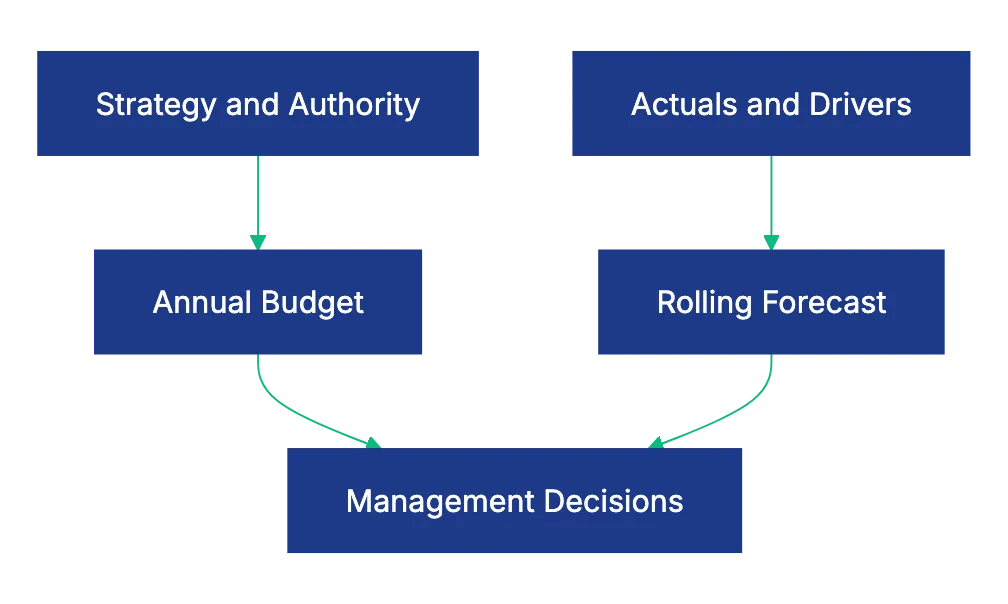
The two outputs should remain distinguishable. Calling every forecast change a revised budget weakens accountability, while treating the original budget as current can produce poor decisions.
Choosing a Rolling Forecast Horizon and Update Cadence
A forecast horizon should extend beyond the longest material decision lead time. A subscription business with rapid demand feedback may get enough visibility from a 12-month rolling forecast. A manufacturer ordering specialized equipment nine months ahead may need 18 or 24 months. A company negotiating multiyear debt or facility commitments may maintain a longer strategic model alongside its operating forecast.
Update frequency should reflect how quickly decisions and inputs change. More frequent updates do not automatically improve forecasts. A monthly cycle is useful when headcount, bookings, collections, inventory, or cash can change materially within a quarter. A quarterly forecast often suffices for a stable business with long contracts and predictable costs.
Use the following decision rules:
- Monthly cadence: appropriate for volatile revenue, tight liquidity, rapid hiring, seasonal demand, or lender reporting.
- Quarterly cadence: appropriate when operating drivers change slowly and a monthly refresh would add little information.
- Event-driven update: useful after an acquisition, major customer loss, financing event, supply disruption, or material pricing change.
- Near-term detail: model the next three to six months by month when cash and execution decisions require precision.
- Longer-term detail: use quarterly periods farther out because false precision creates maintenance work without improving decisions.
For example, a retailer may forecast weekly cash for 13 weeks, monthly performance for the next year, and quarterly results for the following year. These horizons complement rather than compete. The annual budget still controls approved store payroll and capital spending, while the rolling forecast updates expected sales, margin, inventory, and cash.
Driver-Based Planning: How a Rolling Forecast Produces Useful Answers
A rolling forecast works best when it models causes instead of requiring managers to retype every general-ledger line. With driver-based planning, FP&A teams use operational assumptions to calculate financial outcomes. Forecast revenue might equal active customers multiplied by average revenue per customer. Payroll might combine approved positions, expected start dates, salaries, taxes, and benefit rates.
Driver-Based Forecasting Flow:

A practical driver model should include only variables that materially affect decisions. Finance does not need an operational formula for every expense account. Rent may remain a contractual schedule, while revenue, labor, freight, and payment timing receive more attention.
| Business Model | Useful Drivers | Outputs Affected |
|---|---|---|
| SaaS company | Opening customers, new bookings, churn, price, hiring dates | Revenue, commissions, payroll, cash runway |
| Manufacturer | Units, yield, material price, labor hours, capacity | Sales, cost of goods, inventory, capital needs |
| Professional services firm | Consultants, utilization, billing rate, collection days | Revenue, payroll, receivables, cash |
| Retailer | Traffic, conversion, basket size, gross margin, inventory turns | Sales, margin, purchases, working capital |
Consider a 60-person software company. Its annual budget assumes 24 hires spread across the year. By April, recruiting delays leave only five hires. The rolling forecast should move the remaining start dates and recalculate payroll, recruitment fees, software seats, and cash runway. It should not automatically reduce the approved hiring envelope. Management can then decide whether to accelerate recruitment, preserve the cash benefit, or redirect funds through the established approval process.
Rolling Forecast Advantages, Limitations, and Total Operating Cost
A rolling forecast’s strongest advantage is relevance. It updates executives on expected revenue, profit, balance-sheet positions, and cash using actual results and new assumptions. It also simplifies scenario analysis by letting finance change selected drivers instead of rebuilding a spreadsheet.
The annual budget offers something different: a stable commitment. Department heads know their approved limits, the board can compare actual performance with the original plan, and procurement or spend-management systems can apply controls against authorized amounts.
| Approach | Advantages | Limitations |
|---|---|---|
| Annual budget | Clear authority, stable targets, familiar reporting, straightforward variance baseline | Fixed horizon, lengthy negotiation, assumptions can age quickly |
| Rolling forecast | Current outlook, continuous horizon, faster scenario testing, earlier warning of cash or capacity issues | Recurring workload, dependency on timely actuals, risk of excessive detail or shifting accountability |
| Hybrid model | Separates authorization from expectation and supports current decisions | Requires two clearly labeled views and disciplined reconciliation |
Total cost extends beyond software. Finance should estimate the monthly hours continuous forecasting requires from FP&A, accounting, operational owners, and system administrators. It should also account for data engineering, ERP connectors, model maintenance, training, audit support, and access administration.
A spreadsheet-based rolling forecast may be sensible for a small team with one entity and a limited chart of accounts. The economics change when the process requires multiple currencies, intercompany eliminations, granular permissions, concurrent submissions, or repeated consolidation. Then spreadsheet controls can consume more time than analysis.
Rolling Forecast Governance, Controls, and Data Quality
Forecasts are estimates, but still need controls. The ledger should remain the source for finalized actuals, while operational systems supply nonfinancial drivers. CRM software may provide pipeline and bookings; HR systems, employee records and hiring dates; procurement systems, purchase commitments; and treasury or banking feeds, cash positions.
A sound governance model separates responsibilities:
- Accounting certifies actual balances and the close status.
- FP&A owns model logic, consolidation, scenarios, and reporting definitions.
- Operational owners submit assumptions for the drivers they can influence.
- Executives approve material assumption changes and management actions.
- System administrators manage integrations, roles, change logs, and production releases.
The forecast should not ingest provisional actuals without labeling them. If a monthly close takes ten business days, finance can either wait, load a preliminary result with a visible status, or use an accrual estimate and replace it later. Mixing partial actuals with forecasts is worse than using a slightly older, understood dataset.
| Control Item | What to Check | Why It Matters |
|---|---|---|
| Actuals cutoff | Closed periods are locked and dated | Prevents unexplained historical changes |
| Driver ownership | Each material assumption has an accountable owner | Makes review and challenge possible |
| Version naming | Budget, forecast, scenario, and actual are distinct | Stops users from comparing the wrong views |
| Access rights | Editors see only appropriate entities or departments | Protects sensitive payroll and strategy data |
| Change history | Material overrides record author, date, and reason | Supports auditability and learning |
| Reconciliation | Forecast opening balances tie to the general ledger | Prevents compounding balance-sheet errors |
Data quality usually fails at the boundaries. A renamed department, duplicated customer, inconsistent currency rate, or outdated employee start date can distort the model even when its formulas are correct.
Implementing a Hybrid Annual Budget Process and Rolling Forecast
For most small and midsize organizations, a hybrid is the best answer. The annual budget process establishes the approved baseline, while continuous forecasting gives management its latest estimate. Compare actuals with both: budget variance explains performance against commitments, while forecast variance measures predictive accuracy.
A practical setup can follow six steps:
-
Define decisions and outputs. Specify whether the forecast will guide hiring, cash management, inventory purchases, capital timing, covenant monitoring, or all of these. Avoid collecting detail that no decision uses.
-
Select horizon and cadence. Choose 12, 18, or 24 months based on decision lead times, then set monthly or quarterly refreshes based on volatility.
-
Map source systems. Document which data comes from the ERP, CRM, HR, procurement, billing, and banking systems. Assign reconciliation rules before automating imports.
-
Build a limited driver model. Start with the variables responsible for most variation. Run parallel tests against the existing spreadsheet or annual budget process.
-
Establish governance. Define submission deadlines, assumption owners, approval thresholds, version labels, access rights, and the point at which actuals are locked.
-
Measure process performance. Track cycle time, late submissions, manual adjustments, forecast error, and the percentage of model inputs loaded automatically.
Hybrid Planning Cycle:
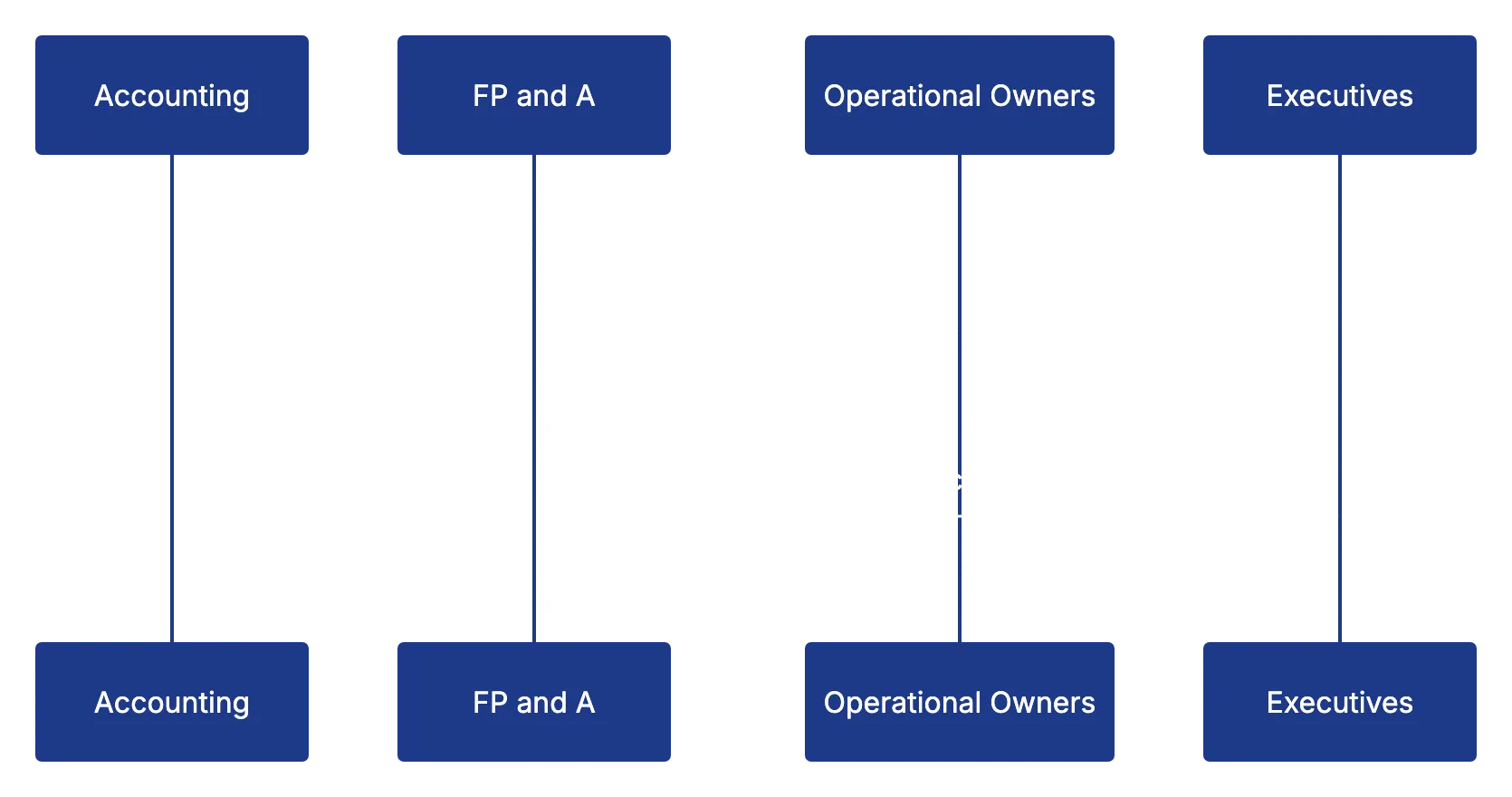
For example, a services company might preserve its approved annual compensation and marketing envelopes. Each month, it updates consultant headcount, utilization, rates, signed backlog, and collection timing. The forecast identifies a six-month cash shortfall, while the budget shows management’s original authorization. Leaders can respond without rewriting history.
Diagram-Ready Planning Calendar
A designer can use this planning calendar directly or convert it into a rolling forecast workflow diagram. It assumes a calendar fiscal year, a monthly rolling forecast, quarterly business reviews, and an annual budget process beginning in September.
| Timing | Accounting and Data | Rolling Forecast Activity | Annual Budget Activity | Decision or Output |
|---|---|---|---|---|
| Business days 1–5, every month | Close subledgers; load preliminary actuals | No submissions while actuals remain provisional | None outside budget season | Preliminary performance view |
| Business days 6–8 | Finalize close; reconcile ERP balances | Actualize closed month; refresh automated drivers | None outside budget season | Locked actual baseline |
| Business days 9–11 | Resolve data exceptions | Operational owners update material assumptions | Department inputs during Sep.–Oct. | Submitted driver changes |
| Business days 12–13 | Validate opening balance sheet and cash | FP&A consolidates base, upside, and downside cases | Finance consolidates first budget draft | Forecast review pack |
| Business day 14 | Publish certified reporting dataset | Executive review and action decisions | Budget challenge sessions in Oct.–Nov. | Approved management forecast |
| Quarter-end month | Complete normal monthly cycle | Extend 18-month horizon by one quarter; review model drivers | Strategy and capital assumptions reviewed in Q3 | Quarterly outlook and scenario set |
| September | Normal close | Normal monthly refresh | Issue assumptions, templates, and calendar | Budget process launch |
| October | Normal close | Forecast supplies latest starting point | Department submissions and challenge | Draft annual budget |
| November | Normal close | Refresh outlook independently of negotiation | Executive revisions and board materials | Proposed annual budget |
| December | Normal close | Extend horizon into the following fiscal year | Final approval and system upload | Approved budget baseline |
| January | Close prior year when ready | Actualize December; retain latest forecast version | Lock original budget for variance reporting | Budget, forecast, and actual views available |
Do not run the full annual budget process monthly. A forecast refresh should concentrate on changed drivers and material exceptions. Requiring every manager to defend every account will reduce participation and delay the numbers beyond their usefulness.
Conclusion
Neither tool is universally superior. The annual budget process is strongest when an organization needs approved targets, spending authority, and a stable accountability baseline. A rolling forecast is stronger when leaders need a current estimate that crosses fiscal-year boundaries and responds to changes in demand, staffing, cost, or cash timing.
For most FP&A and finance teams, a hybrid model is practical. Keep the budget fixed, update the forecast monthly or quarterly, and connect both to certified actuals. Start with a small number of decision-relevant drivers, assign clear owners, and preserve version history. The result should shorten planning and prompt earlier action, not create another elaborate model that only FP&A uses.
Frequently asked questions
Does a rolling forecast replace the annual budget process?
Sometimes, but rarely when the budget authorizes departmental spending, compensation plans, capital projects, or board commitments. A rolling forecast can replace a stale annual forecast while the approved budget remains intact as a control baseline.
How much detail should a rolling forecast contain?
Use enough detail to explain material outcomes and support decisions. Revenue may need product, region, or customer-segment drivers, while office supplies can remain a simple run rate. More rows often increase maintenance, not accuracy.
What commonly goes wrong?
- Managers treat the forecast as a negotiation and submit conservative numbers.
- Finance changes assumptions without retaining the prior version.
- Actuals arrive from the ERP without reconciliation to the close.
- The model copies budget line items instead of using operational drivers.
- Monthly refreshes become miniature annual budgets.
- Leadership penalizes every forecast change, encouraging teams to hide new information.
Forecast accuracy should be measured by horizon and category. A one-month revenue forecast should normally be more reliable than a 12-month estimate. Treating those errors as equivalent creates the wrong incentive.
Should a rolling forecast change approved departmental spending limits?
No. A rolling forecast updates the expected outcome, while the budget remains the authorized spending baseline. If new conditions justify reallocating or increasing funds, management should use the established approval process.
How far ahead should a rolling forecast extend?
The horizon should extend beyond the organization’s longest material decision lead time. Twelve months may suit fast-moving businesses, while equipment purchases, financing, or facility commitments may require an 18- or 24-month view.
Should we update our rolling forecast monthly or quarterly?
Use monthly updates when revenue, liquidity, hiring, inventory, or other key drivers can change significantly within a quarter. Quarterly updates are usually sufficient for stable businesses with predictable costs and long-term contracts. Material events may justify an additional update between scheduled cycles.
Which assumptions should be included in a driver-based forecast?
Focus on variables that materially influence decisions, such as customer volume, pricing, churn, hiring dates, utilization, capacity, or collection timing. Contractual or low-impact costs can often use schedules or simple run rates instead of detailed operational formulas.
Can a small company manage rolling forecasts in spreadsheets?
Yes, particularly when the company has one entity, a limited chart of accounts, and few contributors. Dedicated planning software becomes more useful when the process involves multiple currencies, complex consolidation, sensitive permissions, simultaneous submissions, or extensive manual reconciliation.
How should preliminary actuals be handled during the monthly refresh?
Use finalized ledger balances whenever possible. If the close is incomplete, clearly label preliminary figures or accrual estimates and replace them after certification. Closed periods should then be locked to prevent unexplained historical changes.
How can finance tell whether the forecasting process is working?
Track forecast error by time horizon and category, along with cycle time, late submissions, manual adjustments, and automated-input coverage. The process is useful when it produces timely decisions and earlier warnings, not merely a more elaborate model.