FP&A vs Accounting: Key Differences Explained
Table of Contents
- FP&A vs Accounting: The Practical Difference
- Accounting vs Financial Planning: FP&A Responsibilities
- How Financial Planning and Analysis Uses Accounting Data
- The Monthly Accounting Workflow and Critical FP&A Handoffs
- FP&A vs Accounting Systems and Data Controls
- Metrics for Accounting, Budgeting, and Forecasting
- Four Real-World Accounting vs Financial Planning Examples
- 1. A new employee starts late
- 2. A large customer pays 30 days late
- 3. Cloud spending exceeds budget by 18%
- 4. Management considers opening a second location
- Small-Business FP&A and Accounting Implementation Strategy
- Common Accounting vs Financial Planning Pitfalls
- Bottom Line
- FP&A vs Accounting: The Practical Difference
- Accounting vs Financial Planning: FP&A Responsibilities
- How Financial Planning and Analysis Uses Accounting Data
- The Monthly Accounting Workflow and Critical FP&A Handoffs
- FP&A vs Accounting Systems and Data Controls
- Metrics for Accounting, Budgeting, and Forecasting
- Four Real-World Accounting vs Financial Planning Examples
- 1. A new employee starts late
- 2. A large customer pays 30 days late
- 3. Cloud spending exceeds budget by 18%
- 4. Management considers opening a second location
- Small-Business FP&A and Accounting Implementation Strategy
- Common Accounting vs Financial Planning Pitfalls
- Bottom Line
FP&A vs Accounting: The Practical Difference
The simplest FP&A vs accounting distinction is time orientation. Accounting records and validates what has already happened. Financial planning and analysis uses that history, plus operational assumptions, to estimate what may happen next and help management choose a course of action.
TL;DR: The FPA vs accounting distinction is tidy, but real finance teams are not. The same controller may close the books on Monday, update a cash forecast on Tuesday, and explain a margin variance on Wednesday. Data flows between accounting, FP&A, operations, payroll, accounts payable, and treasury.
Accounting vs financial planning extends beyond job descriptions. This guide examines responsibilities, data, systems, controls, handoffs, metrics, setup effort, and small-business staffing patterns. The goal: accurate actuals, credible forecasts, and less spreadsheet reconciliation.
- Accounting asks: What happened, was it recorded correctly, and can we support it?
- FP&A asks: Why did it happen, what happens next, and what should management change?
- Both ask: Can we trust the underlying data?
Source page reviewed in Chrome during article research. Follow the image link for the current page.
Accounting vs Financial Planning: FP&A Responsibilities
Accounting owns the financial record. Its recurring work includes transaction processing, reconciliations, accruals, revenue recognition, fixed assets, payroll entries, accounts payable, and financial statements. Controllers also maintain policies, approval controls, audit support, and the chart of accounts. Accuracy and completeness come before speed, although a slow close reduces the usefulness of every downstream report.
Financial planning and analysis turns that record into budgets, forecasts, scenarios, performance explanations, and decision support. FP&A may model hiring, pricing, sales capacity, working capital, capital expenditure, or cash runway. It works with department leaders because many forecast inputs originate outside the general ledger.
This comparison shows the usual, not absolute, division of labor:
| Area | Accounting | Financial Planning and Analysis |
|---|---|---|
| Primary time orientation | Historical and current period | Forward-looking, informed by history |
| Core output | Closed books and financial statements | Budget, forecast, scenarios, and management analysis |
| Typical questions | Is the balance correct? Is the entry supported? | Why did performance differ? What is likely next? |
| Main controls | Reconciliations, approvals, posting rules, audit trail | Assumption ownership, model checks, version control, forecast sign-off |
| Common cadence | Daily processing and monthly close | Monthly reporting, quarterly reforecasting, and annual planning |
| Main stakeholders | Controller, auditors, tax advisers, lenders | CFO, CEO, board, department leaders, investors |
The roles overlap. Accounting may prepare cash projections, while FP&A may investigate ledger detail. The sensible boundary is accountability: accounting certifies actuals; FP&A interprets them and manages the planning model.
How Financial Planning and Analysis Uses Accounting Data
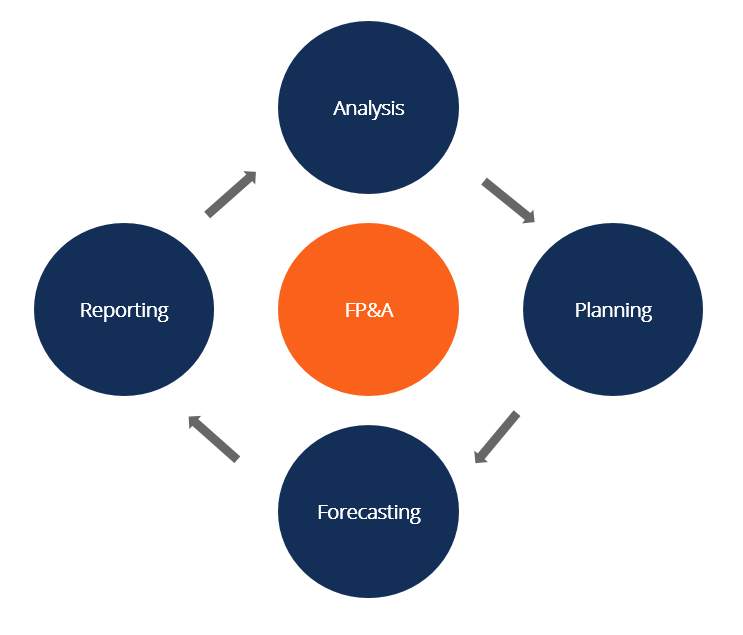
A forecast is only as credible as its starting point. After accounting closes, FP&A receives actual revenue, expenses, assets, liabilities, and cash balances. It combines them with operational data outside the ledger.
Common inputs include:
- Accounting data: trial balance, journal entries, invoices, payment dates, accruals, deferred revenue, and fixed-asset schedules
- Commercial data: pipeline, bookings, contract terms, churn, pricing, and sales capacity
- Workforce data: employees, compensation, vacancies, start dates, benefits, and hiring plans
- Operational data: orders, usage, inventory, production volumes, projects, and vendor commitments
- Treasury data: bank balances, debt schedules, interest rates, covenant measures, and foreign-exchange exposure
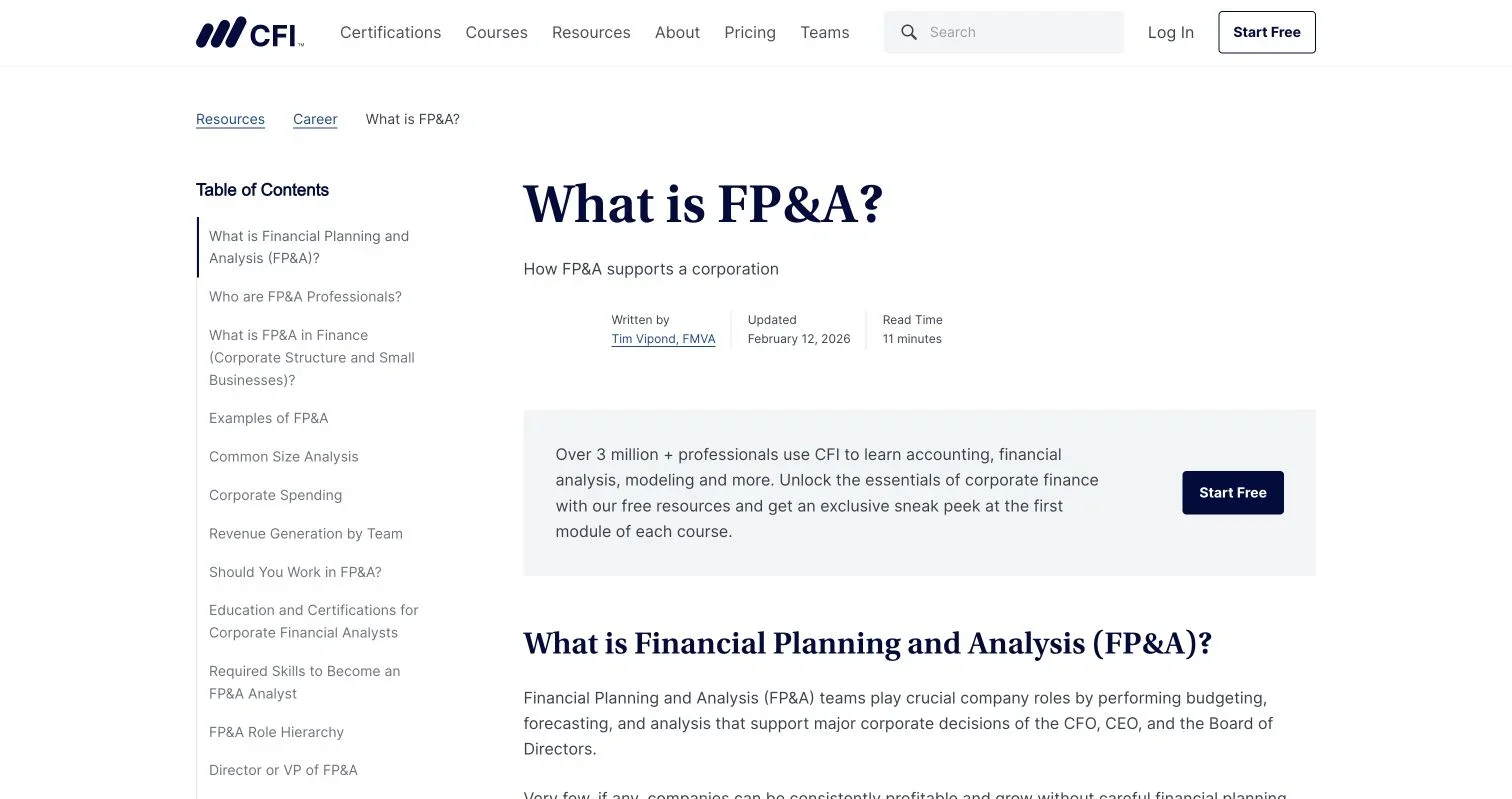
The Corporate Finance Institute’s current FP&A overview describes FP&A as budgeting, forecasting, and analysis supporting decisions by the CFO, CEO, and board. It also draws a useful line between accountants responsible for record-keeping and analysts who examine financial activity and map the company’s financial future. CFI notes that FP&A evaluates both quantitative and qualitative aspects of operations rather than relying on ledger data alone.
Source screenshot: Corporate Finance Institute, “What is FP&A?”, updated February 12, 2026.
A clean ledger does not guarantee a good forecast. Customer, product, department, and project identifiers must also match across the ERP, CRM, payroll system, expense platform, and planning model. Many accounting vs financial planning workflows fail at that mapping.
The Monthly Accounting Workflow and Critical FP&A Handoffs
The monthly workflow should be a controlled relay, not a spreadsheet toss. Accounting sets a cutoff, records estimates, reconciles balances, and locks the period. FP&A loads approved actuals, calculates variances, refreshes the forecast, and works with budget owners on explanations and corrective actions.
A practical workflow has six stages:
-
Prepare before cutoff. Accounting reviews missing invoices, unusual transactions, bank activity, open purchase orders, payroll changes, and recurring journals. FP&A collects preliminary operational drivers such as headcount, pipeline, volume, and pricing.
-
Complete the close. Accounting posts accruals, reconciles balance-sheet accounts, reviews revenue and expenses, resolves material exceptions, and obtains controller approval.
-
Release controlled actuals. The ERP period, extract timestamp, entity scope, currency method, and mapping version are documented. FP&A should not build reporting from an unidentified spreadsheet export.
-
Run variance analysis. FP&A compares actuals with budget, prior forecast, prior period, and relevant operational drivers. Accounting answers classification or timing questions; business owners explain operational causes.
-
Update the forecast. FP&A revises assumptions after separating timing differences from permanent changes. A late invoice may move expense between months without changing the full-year outlook.
-
Publish and archive. Management reporting states the data cutoff, forecast version, assumptions, risks, opportunities, and owners. Both teams retain the approved package and reconciliations.
| Handoff | Owner | Acceptance Test | Typical Failure |
|---|---|---|---|
| Trial balance to reporting model | Accounting | Totals reconcile by entity and account | Extract changes after analysis begins |
| Actuals to forecast | FP&A | Actual months are locked and traceable | Formulas overwrite historical data |
| Variance explanation | Budget owner | Cause, amount, timing, and action are stated | Commentary merely repeats the number |
| Forecast to leadership | CFO or FP&A lead | Assumptions and scenarios are approved | Several files are called “final” |
A one-day delay at the close-to-FP&A handoff can compress management review by the same amount. Teams should measure that handoff rather than treating reporting as one opaque deadline.
FP&A vs Accounting Systems and Data Controls
Software should reinforce ownership. The ERP or accounting platform remains the system of record for posted actuals. A planning platform, data warehouse, or governed spreadsheet can store assumptions, scenarios, allocations, and forecast versions. Expense, procurement, accounts payable, CRM, payroll, and banking systems supply supporting detail.
| System Layer | Main Purpose | Control to Require |
|---|---|---|
| ERP or general ledger | Transactions, journals, balances, and financial statements | Period locks, roles, approvals, and audit history |
| Planning application | Budgets, forecasts, scenarios, and allocations | Version control, assumption permissions, and model validation |
| Data warehouse or integration layer | Standardized data from several systems | Refresh monitoring, lineage, mapping tests, and failure alerts |
| BI and reporting | Dashboards and management distribution | Certified datasets and consistent metric definitions |
| Spreadsheets | Flexible analysis and temporary modeling | Protected inputs, review evidence, naming rules, and controlled storage |
Spreadsheets are not inherently problematic. A transparent workbook can be safer than a poorly configured platform. Trouble begins when spreadsheets simultaneously become an untracked database, integration layer, calculation engine, and reporting tool.
A small team evaluating finance software should test its own chart of accounts and dimensions. Test the awkward cases: a new department, a reorganized account, multiple currencies, late adjustments, and an entity added midway through the year.
| Item | What to Check | Why It Matters |
|---|---|---|
| ERP integration | Supported connector, refresh frequency, and error handling | A connector still needs reconciliation and monitoring |
| Dimensions | Entity, department, product, project, customer, and vendor support | Lost detail weakens variance analysis |
| Permissions | Separate model administrators, contributors, approvers, and viewers | Planning data may contain sensitive payroll or strategy inputs |
| Auditability | User, timestamp, old value, new value, and version history | Reviewers need to reconstruct changes |
| Exports | Usable Excel, CSV, PDF, and API access | Teams must retrieve their data without manual copying |
Metrics for Accounting, Budgeting, and Forecasting
Accounting and FP&A need distinct and shared measures. Otherwise, accounting may complete the close while FP&A receives late or unstable actuals. FP&A may improve forecast accuracy while hiding uncertainty through conservative assumptions.
Useful accounting measures include:
- Days to close: business days from month-end to controller-approved actuals
- Reconciliation completion: percentage of required balance-sheet reconciliations completed and reviewed by deadline
- Post-close adjustments: number and value of entries recorded after the reporting package is released
- Invoice exception rate: invoices requiring manual correction, coding, or approval intervention
- Overdue receivables and payables: balances outside agreed collection or payment terms
Useful financial planning and analysis measures include:
- Forecast error: absolute difference between forecast and actual, stated as an amount and percentage
- Bias: whether forecasts consistently overstate or understate results
- Forecast cycle time: time from actuals release to approved forecast
- Driver coverage: percentage of material lines modeled from operational drivers rather than flat growth assumptions
- Scenario response time: how quickly the team can answer a defined management question with a reconciled model
Shared measures should include data refresh success, mapping exceptions, report delivery time, and unresolved ownership issues. Targets must fit each business. A five-business-day close may be reasonable for one company and reckless for another with inventory, international entities, or complex revenue arrangements.
One warning: forecast accuracy alone can reward timid planning. Track accuracy alongside bias, assumption changes, and decision usefulness. A forecast that identifies a downside range early can be more useful than a single-point estimate that happens to land near the result.
Four Real-World Accounting vs Financial Planning Examples
The difference is clearest when both functions address the same event.
1. A new employee starts late
Accounting records payroll and related accruals for the employee’s actual start date. FP&A changes the workforce forecast, updates salary and benefit assumptions, and determines whether the delay creates a temporary saving or signals a wider hiring slowdown.
- Accounting evidence: payroll register, employment date, accrual support, and cost-center coding
- FP&A decision: revise the hiring schedule, capacity plan, and cash outlook
2. A large customer pays 30 days late
Accounting keeps the receivable open, applies cash when received, and assesses collectability under the company’s policy. FP&A updates the short-term cash forecast and may test whether delayed collections threaten payroll, supplier payments, or a borrowing limit.
- Accounting evidence: invoice, aging report, payment record, and collection notes
- FP&A decision: model cash timing, downside exposure, and collection actions
3. Cloud spending exceeds budget by 18%
Accounting confirms invoices, service periods, account coding, and accrual completeness. FP&A compares the increase with customer usage, product activity, and unit economics. Responses could include a higher forecast, an engineering efficiency project, or revised pricing.
- Accounting question: Is the expense complete and in the correct period?
- FP&A question: Is the variance caused by growth, waste, pricing, or a bad budget assumption?
4. Management considers opening a second location
Accounting supplies reliable rent, payroll, equipment, depreciation, tax, and working-capital history from the first site. FP&A builds base, upside, and downside cases using opening dates, traffic, conversion, staffing, and ramp assumptions.
- Accounting output: supportable historical cost baseline
- FP&A output: projected profit, cash requirement, break-even timing, and risk range
FP&A vs accounting divides accountability, not competition. Each function benefits when the other performs well.
Small-Business FP&A and Accounting Implementation Strategy
A small business rarely needs separate departments initially. CFI observes that the financial analyst position in a small company may effectively be held by the owner, CEO, CFO, or controller. Larger organizations tend to add an FP&A director, managers, senior analysts, and analysts as complexity grows. Its career guide also gives three to five years as a typical transition from junior to senior financial analyst, a useful reminder that software does not replace experienced judgment.
Common staffing patterns include:
| Business Situation | Practical Model | Main Risk |
|---|---|---|
| Early-stage or owner-led | Bookkeeper or accountant plus founder-managed forecast | Forecast lacks discipline or accounting adjustments |
| Growing small business | Controller owns close; finance manager supports reporting and planning | One person becomes the bottleneck |
| Investor-backed growth | Controller and FP&A lead report to CFO | Duplicate models and unclear data ownership |
| Multi-entity operation | Accounting team plus dedicated FP&A analysts | Integration and dimensional mapping complexity |
A sensible setup sequence is:
-
Stabilize the close. Document cutoff rules, reconciliations, account ownership, materiality, and review evidence before buying a sophisticated planning tool.
-
Define reporting dimensions. Decide how entity, department, product, customer, project, and location codes will be governed across systems.
-
Build a minimum forecast. Start with revenue, headcount, major operating expenses, working capital, and cash. A 13-week cash view can sit beside a monthly full-year forecast when liquidity needs closer attention.
-
Assign assumption owners. Sales owns pipeline and bookings inputs; people operations owns hiring dates; accounting owns actuals; FP&A owns model logic and consolidation.
-
Automate proven steps. Replace recurring exports and copying only after outputs reconcile. Keep a documented fallback for failed integrations.
Software costs exceed the subscription. Include configuration, data cleanup, connector maintenance, training, administrator time, model redesign, and parallel runs. Test at least one complete close-and-forecast cycle before making the new workflow the sole production process.
Common Accounting vs Financial Planning Pitfalls
Most accounting vs financial planning failures are mundane. Definitions differ, extracts arrive late, or nobody owns a mapping. Scenario models cannot repair those foundations.
| Pitfall | Practical Response | Evidence of Improvement |
|---|---|---|
| FP&A forecasts from preliminary actuals | Define a formal actuals-release point | Fewer forecast reloads and unexplained changes |
| Accounting changes mappings without notice | Use a shared change log and effective dates | No unmapped accounts in production reports |
| Budget owners enter unsupported numbers | Require driver, source, owner, and commentary | Assumptions can be reviewed and challenged |
| Every report uses a different metric | Maintain a finance-owned metric dictionary | Revenue, margin, and headcount reconcile across reports |
| Planning access is too broad | Separate sensitive inputs and approval roles | Payroll and strategy data reach only authorized users |
| Automation hides failed loads | Add refresh alerts and control totals | Failed integrations are detected before reporting |
Recurring reviews should ask:
- Do reported actuals tie to the approved ledger?
- Can each material forecast change be traced to an assumption and owner?
- Are timing differences separated from permanent changes?
- Did integrations complete, and were control totals checked?
- Can another team member reproduce the reporting package without private files?
The last question is uncomfortable, and useful. If one analyst’s laptop is an important finance system, the process is not controlled.
Bottom Line
The distinction is straightforward: accounting records what happened; financial planning and analysis explains performance and plans what comes next. The challenge is connecting them.
A sound operating model gives accounting authority over actuals, policies, reconciliations, and the close. FP&A responsibilities include assumptions, budgeting and forecasting logic, scenarios, and management analysis. Shared definitions, mapped dimensions, documented handoffs, and control totals keep both sides aligned.
Small teams can combine roles, but not controls. Label actuals and forecasts clearly, preserve version history, assign assumption owners, and test integrations through a complete monthly cycle. Buy software only after defining that workflow. Automation removes repetition; it cannot decide who owns the number.
Frequently asked questions
Does a small business need a dedicated FP&A professional?
Not necessarily. A controller, finance manager, CFO, or owner can handle planning initially, provided accounting actuals and forecast assumptions remain clearly separated and controlled. A dedicated FP&A role becomes more valuable as the business adds entities, investors, departments, or complex operating drivers.
When should FP&A begin updating the monthly forecast?
FP&A can collect operational inputs before month-end, but it should update official reporting only after accounting releases controller-approved actuals. The release should identify the period, entities, currencies, extract time, and mapping version so the forecast has a traceable starting point.
Who should explain budget-to-actual variances?
Responsibility is shared. Accounting resolves questions about timing, classification, completeness, and posting, while department leaders explain operational causes; FP&A connects those findings to the forecast and recommended actions. A useful explanation states the cause, financial impact, timing, owner, and response.
Can spreadsheets be sufficient for budgeting and forecasting?
Yes, especially for a small team with a relatively simple business model. Workbooks should have protected inputs, documented formulas, clear version names, review evidence, and controlled storage. A planning platform becomes more valuable when collaboration, permissions, dimensional complexity, or frequent scenario analysis becomes difficult to manage.
How should a company handle changes made after the books are closed?
Accounting should document and approve post-close entries under a defined materiality policy. FP&A should reload actuals when the change is material, preserve the previous reporting version, and identify which forecasts or management reports were affected. This prevents unexplained differences between the ledger and planning model.
Which metrics best show whether accounting and FP&A are working well together?
Useful shared measures include the time from month-end to approved actuals, the time from actuals release to an approved forecast, mapping exceptions, failed data refreshes, and post-close adjustments. Forecast error and bias should also be reviewed alongside assumption changes and whether the forecast supported timely decisions.
What should a business fix before buying FP&A software?
First stabilize the monthly close, define reporting dimensions, assign data and assumption owners, and agree on handoff controls. Then test prospective software using real accounts, entities, currencies, reorganizations, and late adjustments. Automating an unclear process usually makes its problems emerge faster and become harder to diagnose.